
250 years ago a choice was made.
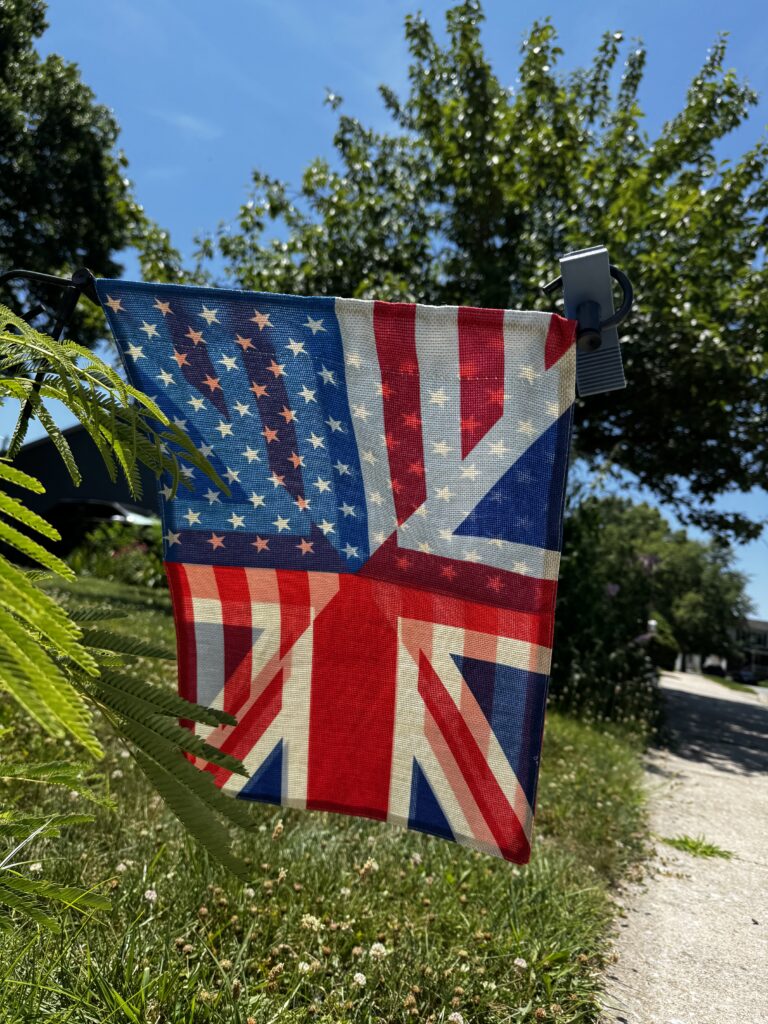
This was not inevitable.
Nor was the country that came after it.
And choices have continued to be made.
What Comes Next?
In the musical Hamilton, when George III realizes he’s lost the colonies, he switches from asserting ‘you’ll be back’ to asking “What comes next?…Do you know how hard it is to lead?”
Americans were about to find out.
A New Constitution
A constitution was hammered out, 11 years later, “in Order to form a more perfect Union, establish Justice, insure domestic Tranquility, provide for the common defense, promote the general Welfare, and secure the Blessings of Liberty to ourselves and our Posterity.”
After the decision was made, Elizabeth Willing Powel asked Benjamin Franklin, “Well, Doctor, what have we got, a republic or a monarchy?”
Franklin’s cranky reply? “A republic, if you can keep it.”
A balance of power was put in place, to keep the branches of government working in harmony, to prevent tyranny, authoritarianism. Everyone was invited to participate.
But of course, NOT EVERYONE was invited to participate.
And so began the actual work of creating a more perfect untion and securing the blessings of liberty, and clarifying who belonged in the category of ‘ourselves’ in posterity.
Revolutions Sound More Fun Than They Are
“Burn it all down and start again’ sounds like a cool idea, but only if you don’t look at the consequences. People die — usually not the people in power. Everyone hates everyone else. Nobody agrees with anyone, until eventually, grumpily, the ones who remain standing, compromise.
It takes a long time. It disrupts society, and the economy.
And the people who wrote the US Constitution remembered what that had been like.
The Pressure Valve
So they wrote a constitution that could be a living document, one that could be amended, as a pressure-relief valve. When an issue became problematic, or when more information gave us greater understanding of how life works, or when hearts were stouter and momentarily more courageous, we could add to the living document that explains and improves the country.
And the people of the US have chosen to do so 27 times.
Did you know Senators weren’t elected by popular vote until 1913? (There’s hope yet for your Upper House, UK…).
Some amendments happen fast—the first 10 were adopted a mere three years after the Constitution was ratified—some happen slowly. (The most recent amendment, the 27th, was first proposed in 1789. It was ratified in 1992!)
Some have yet to happen: The Equal Rights Amendment, which says that “quality of rights under the law shall not be denied or abridged by the United States or by any State on account of sex” was proposed in 1923, passed by Congress in 1972, and ratified by the 38th state (Virginia – 38 is the minimum number of states that must ratify an amendment to let it take force) in 2020.
It is still not officially the law of the land though, because of legal nit-picking.
(Awesome. Wow.)
The Only Constant Is Change
And in a democratic republic, the populace has a say in that change.
Every vote has a consequence. Often those consequences aren’t felt for decades.
Voting for Kennedy (Democrat) got us to the moon, but also got us Lyndon B. Johnson, who both doubled down on Vietnam AND signed the Voting Rights Act.
Voting for Nixon (Republican) got us the Environmental Protection Agency, a lowered voting age (18), anti-ballistic missile treaties and the worst scandal ever to rock the presidency, leading to his resignation. (Oh, the innocent old days when a scandal could take down a president!)
Nobody ever voted for Gerald Ford (*for President. Look it up!)
Voting for Carter (Democrat) got the first LGBTQ rights activists invited to the White House and lifted the ban on their serving in the armed forces (this will come back in the Clinton era); it got us pardons for Vietnam draft dodgers, and an attempt to broker peace on the world stage, including signing the SALT II Nuclear Disarmament agreement with the USSR. He also worked poorly with Congress and oversaw internal party struggles that led to the party’s defeat in the next election.
Voting for Reagan (Republican) resulted in new wealth for some, and a yawning silence when AIDS cut down thousands of Americans in the prime of their life (and tax-paying years! C’mon, Republicans, let’s get real!), because the people who were most affected were in a group that was an unpopular minority. It also got us a powerful cadre of behind the scenes power brokers who introduced the idea of ‘spin’.
Voting for George HW Bush (Republican) resulted in the passing of the Americans With Disabilities Act, an Immigration Act that expanded visas and made the process more humane, and Clean Air Act Amendments passing, but also led us into a war in the Gulf that would have consequences for decades.
Voting for Clinton (Democrat) resulted in the Brady Handgun Violence Prevention act, a gun control measure named for Reagan’s press secretary, paralyzed in the assassination attempt on Reagan. It also led to a Crime bill that enacted ‘three strikes and you’re out’ a draconian policy that mean three convictions could result in citizens being jailed for arbitrary lengths of time, disproportionate to their actual crime, leading to prison overcrowding and pertinent questions about the racial make up of the people being prosecuted. Clinton also kicked the can down the road on the matter of whether homosexual service members should be afforded the same rights and priveldges as their heterosexual colleagues and instead told them to pretend they didn’t love who they loved. Great. He also failed to do anything about the rising threat of Al Qaeda, even after the 1993 attack on the World Trade Center in New York. He also failed to resign after a scandal, something that would set a precedent.
George W. Bush (Republican) came in as a former governor who had turned his state (Texas) into the US’s leading center of wind power. He tried to improve education, especially for children in poorer districts, with his No Child Left Behind Act. Turns out it was a failed experiment, but it was a worthy aim. His administration was knocked off its plans by the legacy of Clinton’s failure to deal with the threat of al Qaeda. Then he plunged us into a confusing and poorly defined series of wars. But he also presided over changes to medicare that improved access to prescriptions for senior citizens, but tried to introduce ‘market forces’ into healthcare — a sector that will ALWAYS have more demand than supply. And he let congress deregulate financial industries leading to a catastrophic global recession.
Barack Obama (Democrat) came in during the worst global recession in most people’s memory, and with the legacy of Bush’s ‘market driven’ changes to healthcare having led to a diminution of most people’s freedoms: the freedom to change jobs is hampered when the only way you can pay for your kids’ healthcare is through your corporate funded health insurance plan. Your freedom to live where you want, or start a new business are similarly hamstrung. So his job was to fix the economy and overhall healthcare so that most people at least had access to health insurance plans, with no lifetime limits on coverage, and some subsidies for the most financially needy. When the Supreme Court finally extended the freedom of consenting adults to enter into monogamous relationships under the full protection of the law, the White House was lit in rainbow colors — 20 years after Don’t Ask Don’t Tell was implemented by a Democratic president. It would take another 9 years before another Democratic president got to sign a law guaranteeing this right. He also failed to end the wars he inherited.
And then there’s the last 10 years….
Choices Have Consequences
It’s not perfect. But we strive, always, to make it more perfect.
Every vote has consequences, and we often don’t see those consequences for decades. But we can lengthen our view, looking back and looking forward, and make choices the way the Founding Fathers did,
“in Order to form a more perfect Union, establish Justice, insure domestic Tranquility, provide for the common defense, promote the general Welfare, and secure the Blessings of Liberty to ourselves and our Posterity.“
Happy Birthday, America.
I wonder what comes next?
Thanks Julie – this is so well said, and especially appreciated today.
Thanks Anne. Impressed you made it to the end of this! ;)
Love to you and yours and Happy Independence Day!