Yesterday was the anniversary of the day my Dad left us.
This week, my dear friend Marta’s father joined him in the great whatever.
A week or so ago, a friend my age finally stopped being able to outrun the chronic illness that should have prevented him doing the many remarkable things he did with his life four decades ago.
Writing About Grief
I wrote an article (forthcoming) for a writer’s blog about Writing Through Grief, not because I have any academic qualifications to do so but because I have been alive for 54 years and in that time death has knocked me about a bit—sometimes a glancing blow, sometimes a breath-stealing punch. And yet, I continue to try to create.
I’m not going to preempt that article here, but rather to ramble on about life, death and the things that come with them.
Marking The Moment
On her blog today, Marta talked about the various ways people leave the world and but also about the ways we mark and ritualize it.
She talked about time spent in Bulgaria, and how people there put up death notices in public, which I kind of loved.
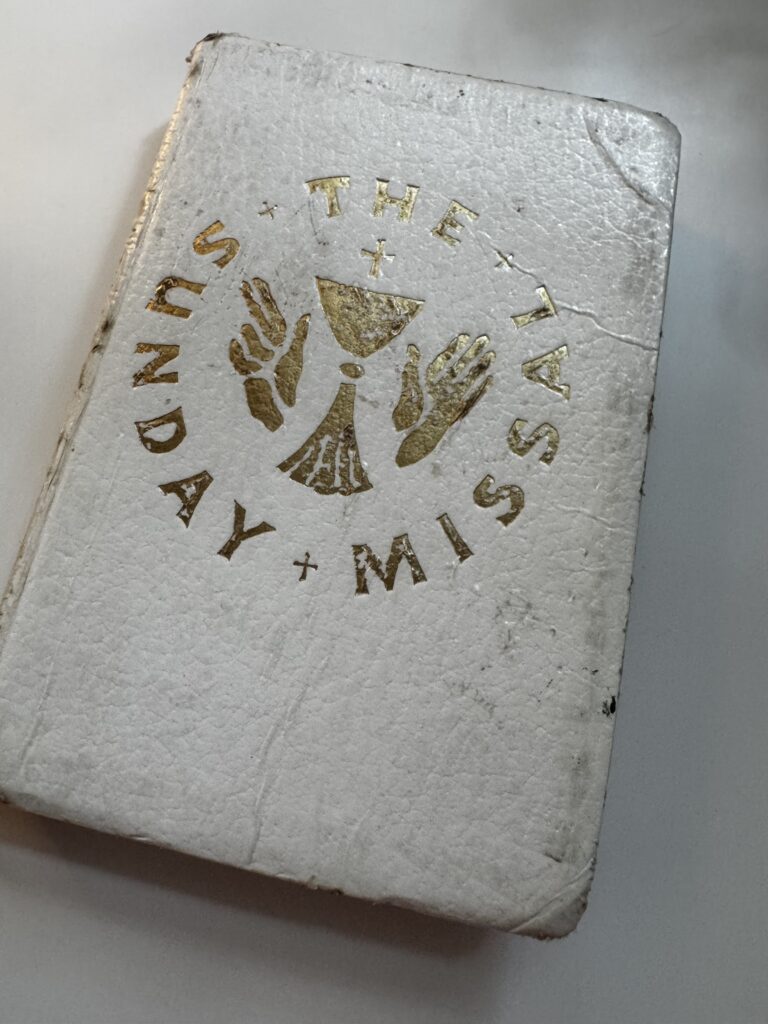
In my little corner of the Roman Catholic tradition, we had our own personal ‘missals’ —a book containing the ‘Order of the Mass’ with all the prayers along with the weekly readings in it (a Vatican II innovation, I’m sure).
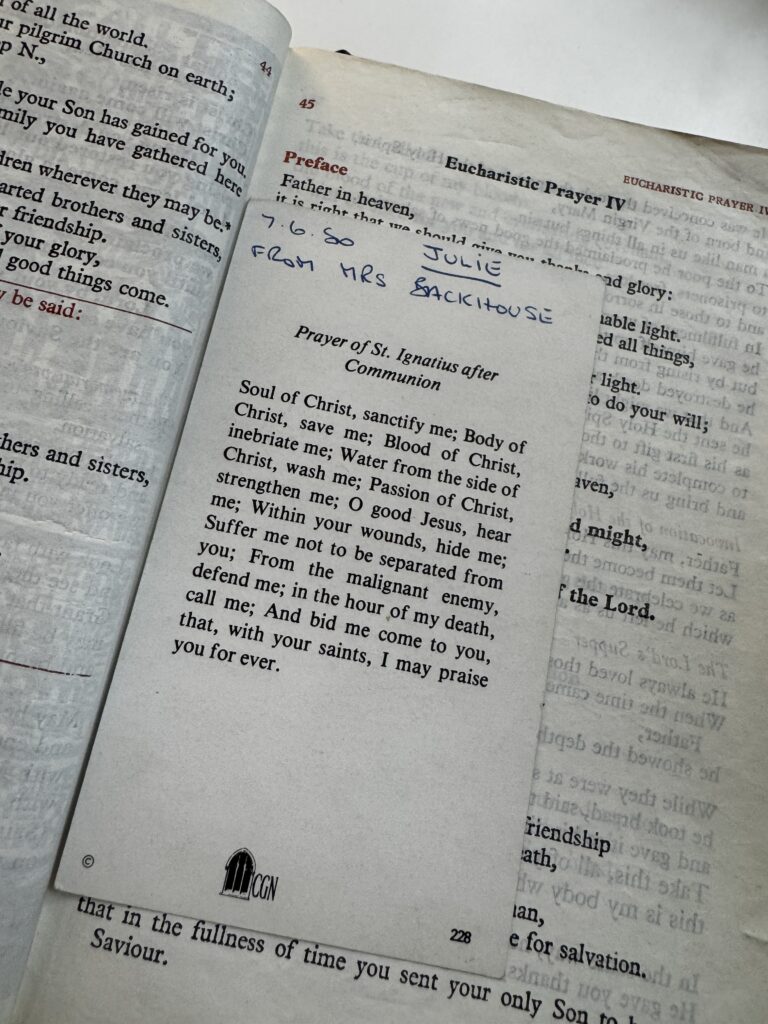
Whenever anyone died, their loved ones would give out ‘prayer cards’ at the funeral. They always ended up inside our missals.
I still have my missal.
It is stuffed with prayer card ‘bookmarks’, including cards to mark other occasions, like this one from my teacher on the occasion of my First Communion.
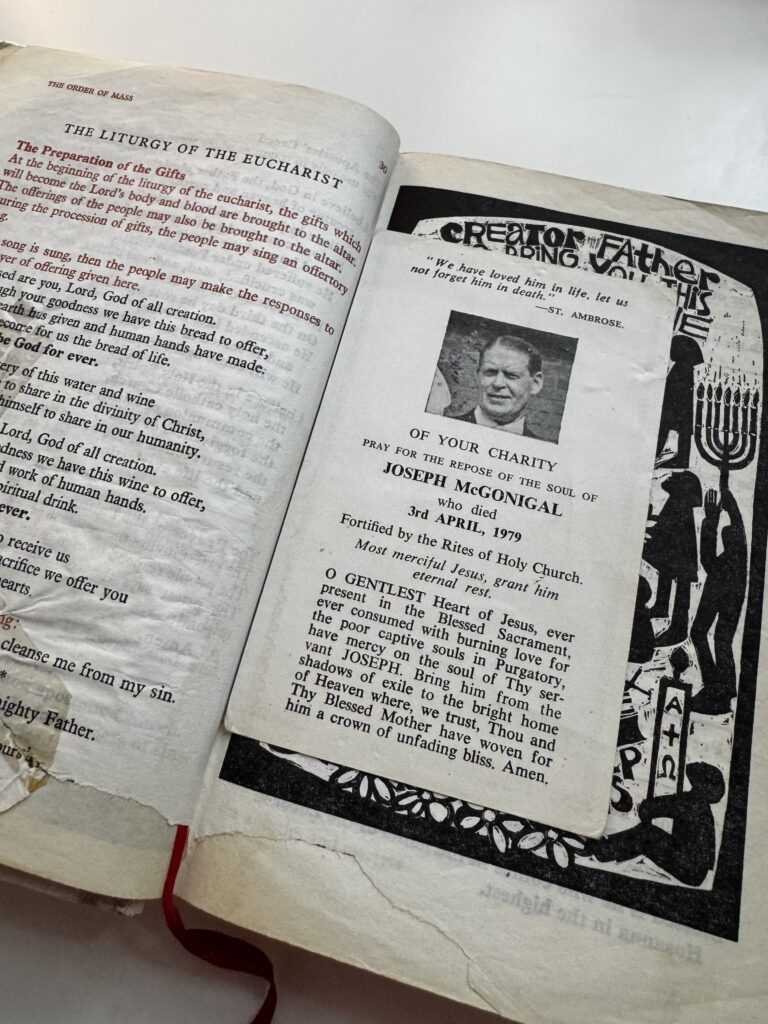
Side note: I initially thought the art in these missals was exceedingly ugly, but over the years came to really love it.
We marked the anniversary of a death by going to mass or having the day’s mass dedicated to them, or by having a special mass said in their honor.
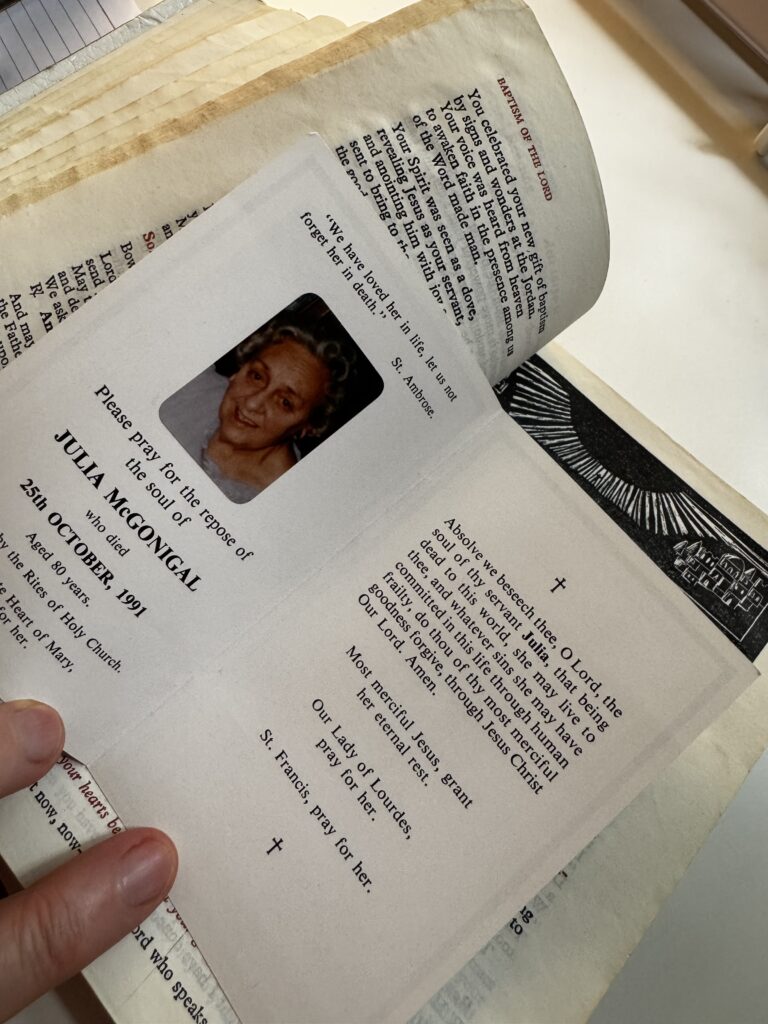
I think many Catholics still see these ‘offerings’ as a kind of spiritual ‘get out of Purgatory free’ card, but a, I’m not sure that’s been doctrine since the Reformation and b, I don’t think that was the real value.
I was pretty young when I decided that God was gonna do whatever God was gonna do, but the earthly sacraments were all about helping us to be better people, together.
“Forming the Kingdom of God on earth,” as some liturgy or other said.
(We weren’t required to memorize chapter and verse as if to pass a test. We were required to show up at least once a week and have the language drilled into our existence. As an illustration: try going to a Star Wars film with a Catholic-of-a-certain-age and hear them giggle as they repress the urge to reply to ‘may the force be with you’, with ‘and also with you’…)
Post-Religion, Pro-Ritual
The country I grew up in was nominally Christian, with a different denomination assigned as the ‘official church’ in Scotland and England (see: Reformation — I don’t know about Wales, and the less said about official religions in Northern Ireland, the better).
The reality, though, was that very few people were regular church-goers by the time I came along. We’d moved beyond careless agnosticism into the era where proselytizing Atheism was breaking out of the bonds of intellectual institutions and becoming populist.
The same is happening in the county I live in now—though it’s less a rejection of everything supernatural and more a dizzying kind of acceptance of anything but traditional religions…
(…which have definitely earned their seat on the naughty step.)
All of this leaves us with a vacuum in the rituals space.
People write their own wedding vows and invent birth and death celebrations that are more personalized and meaningful, which is, on the whole, positive, I think.
But I also think it puts an awful lot of pressure on people who are in the most stressful and disrupted moments of their lives.
My own father’s funeral was stressful and sad, yes, but we also knew, more or less, what was expected—and if we didn’t, there were people we paid to say, “What people normally do is…” If we couldn’t face a hard decision we just pointed and picked one of those ‘normal’ options.
We understood the order of events:
- First the church, and a mass;
- Then the crematorium with a few more prayers;
- Then the greeting line, to say thank you to everyone who came;
- Then the party at a local hotel, because we’re Scottish and who wants to exit this life without their nearest and dearest gathering to tell stories and make each other laugh over a few sandwiches and sausage rolls, something warm in a china cup, and then, OK if you insist, a wee dram…as if you had simply stepped out of the room, for a while?
- And then the first steps into the rest of your life.
(Which is, of course, where the wheels come off, because we don’t have rituals for that part. The Bulgarians at least had the smarts to put up a death notice on certain anniversaries. The Catholics know to mark the anniversary. But where are the rituals for turning off bank accounts and filing survivor benefits and learning to go grocery shopping on your own? We could do better.)
I barely made it through trying to pick the right music to play him out. I’m glad the rest of it didn’t have to be invented.
All this to say: death is all around us. It defines everything, and makes everything valuable.
Before I Die
I think about death all the time. (I think this is one of the great gifts of a Catholic upbringing, where you’re forced to think about death as soon as you’re old enough to hear the word; where, once every spring someone smears ashes on your forehead and says, “Remember you’ll be dead some day. Don’t waste your life making other people’s lives harder. And by the way don’t wipe off the ashes when you leave the safety of the church.” I assume a person is given bonus points for doing this in a region where publicly identifying as the ‘wrong’ denomination felt like inviting that day to come sooner, or at least feel like a relief).
I think about how grateful I am to be here, at this age, with these physical complaints and spiritual groanings, when so many people didn’t make it this far.
I think about how many projects I might have time to complete if I am allotted an average span of years, and how that number could be 0, unless I force myself to focus and do the difficult parts.
I think about how much I don’t want to be regretting things, if I have time to realize I’m on the way out.
I worry that I don’t reach out to people I love, enough, while I can. I try not to feel guilty about that, lest I sink into a self-recriminating paralysis and, you know, fail to reach out even more.
If we lived forever, how would we ever get anything done?!
Inconclusion
I feel I should finish with something profound. Or maybe I should, at least, go back and try to make this post coherent.
But no. This isn’t a post for the algorithm. This isn’t even really a post for you (though, if you have stumbled across it, welcome. I hope it makes you feel less alone.)
This is a post for me to think through my current thoughts in the only way I know how. Through my fingertips. (And posted on this blog because I like to be able to find things later).
I think about death a lot. It blunders into my way, often. So far it has not ended my story.
And oh, maybe that’s my profound point: I have not felt—in the slightest—that my father’s story ended with his death.
The lives he touched, the people he shaped, the way I think, the way his grandchildren talk about him…all of this continues.
The song is ended, but the melody lingers on.
Or, since he generally preferred the Gershwins to Irving Berlin: they can’t take that away from me.
My father was Catholic and I went to Catholic school for a few years (enough for it to have affected me but not enough to feel particularly bound by it). And this all resonates. I think about death every day. When I saw how the Bulgarians acknowledged death, I knew I was in the right country. They don’t usually take the posters down either. They wear away in the weather. So on the walls where the posters tend to be (bus stops in particular), you can see posters that are faded and old right next to one that is brand new.
And this line–“If we lived forever, how would we ever get anything done?!” Was a truer thing ever said?